

Skeezy Steve 2
Periodically updated series with no set schedule

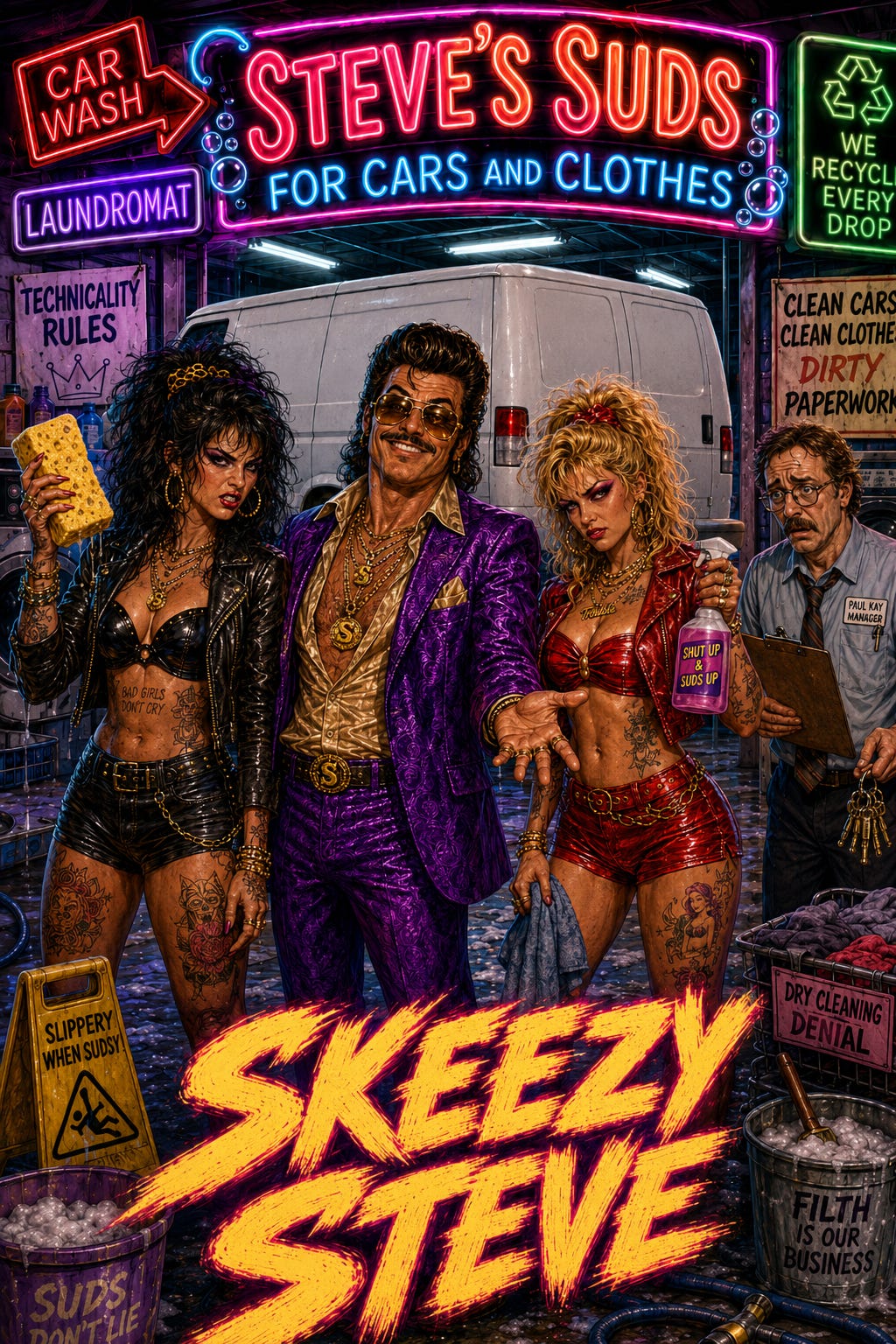
Listen, my name was Lawrence Ortiz.
I knew what the office door said.
The office door said, PAUL KAY, MANAGER in white vinyl letters that had outlasted whatever dignity I had left when I accepted the job. Every morning I walked past those letters and told myself I would fix it eventually.
Then afternoon happened and I was tired.
Then Friday happened and the check cleared.
And that was how I got got.
Not by Skeezy Steve specifically. That would have been too simple. No, this started earlier. This was a trend. A lifestyle choice imposed by the universe.
Before Steve’s Suds for Cars and Clothes, I had worked for Basement Games LLC. It was clean. Respectable. Legal. I wrote code in a climate-controlled building with glass conference rooms and motivational posters that looked like they had been designed by a hostage with access to stock photography.
They called us a family.
That should have warned me.
Families didn’t usually require login credentials or quarterly metrics. Families also didn’t usually have a woman named Denise from the Department of Employee Investment saying, “Think of this as a lateral move in line with your performance,” while smiling like she’d practiced it in a mirror until it stopped meaning anything.
Basement Games reduced me to employee number 67335. Then they fired me over a webcam on a weekend and sent me a PDF with a crisis hotline number forty-three minutes later.
Skeezy Steve never called anyone family.
He lied constantly, but he never called anyone family.
He hired me because my last name was Ortiz and the laundromat sat three blocks from my apartment. He never asked if I spoke Spanish. He just assumed.
I never corrected him.
In my defense, I needed the job, and silence was technically not a lie.
That was the first Skeezy rule I learned.
Unfortunately, I learned it from me.
We were in the office, which at the time didn’t have my wrong name on the door yet. It had no name at all. Just old tape marks and a faded outline where somebody else’s authority had been peeled away.
Skeezy sat behind the desk wearing a black loosely buttoned shirt, tan alligator skin shoes too expensive for the floor they were touching, and sunglasses.
“What name you want on the check?” he asked, opening a payroll form and clicking a pen.
I thought he was messing with me.
People did that sometimes. Not always with malice. Sometimes just curiosity wearing bad manners. Ortiz became a question before I even opened my mouth. How do you say it? Where are you from? No, where are you really from?
So I decided to be a smart-ass.
“Por qué?” I said.
Sarcastically.
Badly.
With the confidence of a man who had learned Spanish from menus and apologies.
Skeezy nodded, wrote something down, and moved on.
I didn’t think about it again until the first check came.
It said Paul Kay.
I opened my mouth.
Then I closed it.
Then I told myself I’d fix it next time.
The next check cleared.
By then the office door had vinyl letters.
By the end of the month, Paul Kay had a vendor login.
By the end of the quarter, Paul Kay had signed an inspection form next to a diagram of the recycling system that looked like a confused octopus drawn by a three-year-old.
I wasn’t Paul Kay.
But Paul Kay had a door, a check, a vendor login, and a signature on an inspection form.
Paul Kay had better evidence.
Steve’s Suds had two promises printed on the sign out front: CLEAN CARS. CLEAN CLOTHES.
I had worked there long enough to distrust both.
The building sat across from a taqueria and a mercado with a mural of a saint watching the parking lot like she wanted license plate numbers. The laundromat took the left half. The car wash took the right. Between them, hidden in the walls, ran a hallway of pipes and hoses that kept everything working in a way I refused to understand.
Across the front, in big bold letters, were the words: WE RECYCLE EVERY DROP.
It wasn’t a lie.
That was the thing with Skeezy Steve. He had a way of turning lies into something technically true. The claim worked if you counted “forgetting to drain something” as recycling.
I asked where the filter was once.
Skeezy pointed at a series of pipes, then made a circle in the air with one finger.
“The journey is the filter,” he said.
I needed the job, so I let that answer live.
The customers didn’t care.
That was the part that depressed me in a practical way. Not poetic depression. Not rain-on-the-window depression. Fluorescent depression.
They liked the prices. They liked that the dryers got hot enough to forgive most sins. They liked that the car wash took their vehicles out of sight for a more “thorough” cleaning.
Mostly, they liked the staff.
Not because the staff was friendly.
Because the staff didn’t speak English.
Skeezy said it made people comfortable.
What he meant was that customers liked being able to complain in English without risking an English-based rebuttal.
It was vile.
It worked.
That was Skeezy’s business model.
Vile.
But worked.
The staff spoke Spanish around customers and mostly English around me. It should have raised questions. A lot of things at Steve’s Suds should have raised questions. The smell near bay three. The “night security” guy in a white tank top and cargo pants who insisted he worked there despite no paperwork, no schedule, and no evidence he had ever been awake after sunset.
But by then I was already answering to Paul Kay.
Deep enough into it that I had forfeited my right to question anyone else’s name tag.
I didn’t know Jose yet.
That came later, as most workplace punishments did.
I suspected Jose wasn’t who he said he was the first time I met him. Customers looked at him and saw what made them comfortable. He had dark hair, calm eyes, and wore the Steve’s Suds polo with JOSE stitched crookedly over the chest.
His Spanish, however, was interpretive.
Mostly restaurant phrases. Some things I was pretty sure came from porn.
I didn’t ask.
Asking would have required me to admit I knew enough Spanish to object.
Sometimes he would lean across the counter and say something with such warm confidence that the customer would nod, smile, and hand over money. I understood maybe one word in four, and two of those words made me nervous.
Once, a woman complained that washer eight had stolen her quarters.
Jose gave her a sorrowful look and said, “Sí, señora. Hace mucho calor y está muy húmedo.”
The woman apologized to him.
I almost understood what he said. I was pretty sure we had seen the same movie.
What I disliked about him was that he occasionally used air quotes when he called me “Mr. Kay.”
I hated the air quotes.
They were accurate.
Skeezy didn’t care who was lying about what as long as the customers were happy, the money flowed, and nobody important wrote anything down.
That should have made him worse.
Instead, it made him less insulting than Basement Games.
At least here I had a name.
Even if it wasn’t mine.
I was thinking about this while the office television played a judge show with the sound off. Two men pointed at each other while an ancient woman in glasses looked disappointed in both of them.
On my desk sat three invoices addressed to Paul Kay and a sticky note from Jose informing me that washer six was once again “irrespetuosa.”
I assumed that meant broken.
I planned to ignore it.
No inspectors had come in.
No leaks had started.
Washer six had its scheduled breakdown.
The day was going well, all lies considered.
Then Jose ruined it.
“Boss is here,” he said.
I sat up too fast and cracked my knee against the desk.
“The boss-boss?”
Jose looked at the door, then at me.
“Not jefe. Big boss.”
My knee stopped mattering.
“Skeezy’s here?”
Jose nodded.
“Outside. With two chicas.”
“Customers?”
Jose gave me a look my father used to give me before calling me a dumbass.
Right.
Stupid question.
Skeezy Steve alone was a problem.
Skeezy Steve with company was paperwork.
I stood and moved to the blinds.
Outside, Skeezy Steve had dismounted from a moped that looked too small for one person, let alone three. He spread his arms like he was presenting the building.
One woman was a dark-haired brunette in black leather, glaring at the world like it owed her bail money.
The other was blonde, dressed in red, smiling in a way that made me think of knives with lipstick.
They both looked angry.
“Oh no,” I said.
Jose stepped beside me.
“You in trouble, jefe.”
I moved back to the desk and pulled out two twenties.
“Take lunch.”
“It’s ten-thirty.”
“Take an early lunch.”
“Mama made lunch.”
“Beer break.”
Jose looked at the money.
Then at me.
Then back outside.
He didn’t take it right away.
Instead, he grabbed my hand and leaned in.
“If he asks for the Skeeze-Machine, say no.”
He squeezed hard.
I stared at him.
“The what?”
“The Skeeze-Machine.”
“Jose.”
He winced slightly at the name. I noticed and immediately filed it under Things I Had No Right To Pursue.
“The van?”
“Sí.”
Of course.
The van.
That van.
“It’s not my—”
Jose pointed at the key ring by the door.
Right.
Paul Kay had keys.
I sighed.
Jose finally took the money and left.
Seconds later, someone slapped both hands against the glass front door.
Not knocked.
Slapped.
I opened it.
Skeezy Steve stood there, grinning like bad news had finally found a ride.
“Paul Kay!” he shouted.
My stomach renewed its objections.
I stepped back as he walked in, followed by the brunette and then the blonde, both still angry.
Hopefully they weren’t here to dispose of the guy pretending to be Paul Kay.
More than likely, they’d off Lawrence and invoice Paul.
Skeezy Steve made a beeline straight for me.
“Paul Kay!” he shouted again, clapping me on the shoulder like we were celebrating something instead of entering a situation.
“Señor,” I said.
“These are my associates,” he said, sweeping one arm toward the women while winking at me.
The brunette arched one hip forward and crossed her arms, a look of disgust fixed firmly on her face.
“This is Maddie,” Skeezy said.
The blonde let her right hand dangle over Maddie’s shoulder. I wasn’t sure if she was going to grab a handful, but the look on her face made me think she’d stab me first.
“And this,” he said, turning to the blonde, “is Sadie.”
Sadie smiled at me like a wolf.
“Hi, Paul,” she said slowly.
I flinched internally. Externally, my eyes strained not to become the baser version of myself.
“Hola,” I said.
“You said we were taking your car,” Maddie said, turning toward Skeezy.
“Did I say car or vehicle?” Skeezy replied.
“We rode here on a moped!”
“You mean the Skeeze-ter,” Skeezy corrected.
“You just wanted us pressed against you,” Sadie growled.
“Baby, the Skeeze-ter is about togetherness.”
“You’re disgusting,” Sadie said.
“And vibrations,” Skeezy added.
“That was involuntary!” Maddie snapped.
Skeezy elbowed me in the chest. “She wasn’t complaining at the time.”
“Why are we here, Steve?” Maddie shifted her weight.
“I told you why. Debts to be collected.”
With that, Skeezy pulled out a folded sheet, smoothed it against his chest with inappropriate reverence, and handed it to me.
I looked down. It wasn’t a rental agreement or a waiver. It was a debt acknowledgment with the words ONE RIDE. NO QUESTIONS. CLOTHING OPTIONAL ADD-ON typed in bold letters. Below it was my handwriting: Paul Kay. I had signed this at some point. Maybe. I couldn’t remember when.
“One ride, no questions, clothing optional add-on,” I read aloud.
“It’s not optional,” Sadie said.
“Mostly context,” Skeezy replied.
I looked up. Maddie was staring at me like I had personally invented this document.
“The Skeeze-Machine is a panel van?”
“It is not a panel van,” Skeezy said.
“It’s a panel van,” Sadie sighed.
“You have a vehicle called the Skeeze-Machine?” Maddie tilted her head at me.
“No. Sí?” I said.
“Yes,” Skeezy nodded emphatically.
I took a breath.
“Van out back.”
“Mobile. Party. Platform,” Skeezy said, punctuating each word with a gesture.
“Van,” Maddie said.
“Lifestyle,” he replied.
“That one I’ll believe,” Sadie said. “It definitely is a lifestyle.”
Never had I missed being employee number 67335 more than in that moment.
“Anyway,” Skeezy said, throwing his hands up for silence, “if you would be so kind to get it ready for us, Paul Kay.”
Maddie narrowed her eyes.
“Wait.”
“Paul Kay.” She looked from Skeezy to me, then back again.
I stood very still.
“Come on, Maddie,” Sadie said, trying to pull her toward the door.
“No, hold on.” Maddie resisted and pointed at me. “His name is Paul Kay?”
“That would be what’s on his check,” Skeezy said.
“Paul. Kay,” she repeated slowly.
My stomach decided it wanted no part of this and was very angrily threatening to exit my body through my ass.
Maddie’s smile sharpened. “Isn’t that just—”
“Don’t,” Sadie said.
“What?”
“Don’t do whatever it is you’re about to do.”
“His name is clearly—”
“Don’t erase him,” Sadie said.
“I’m not erasing him. I’m solving him.”
“You don’t get to solve a man’s name in public.”
“It’s not his name.”
“You don’t know his journey.”
“He just said señor like a man falling down stairs.”
“You can’t comment on his name. That’s racist. And we ain’t racist here.”
“Ladies, please,” Skeezy shouted. “I can fix all of this confusion.”
Then he turned to me, suddenly serious.
“You’re Paul Kay, aren’t you?”
Every washer in the building seemed to get louder.
The words wouldn’t come.
“Sí,” I said.
Then, because the universe wasn’t done with me, I added, “uh, señor.”
Skeezy turned back to them, throwing his arms wide.
“See? His name is Paul Kay.”
“Something is wrong here,” Maddie said.
“Yes,” I said.
Everyone looked at me.
“With washer six,” I added.
Cowardice was mostly improvisation.
“Anyway. Wheels.” Skeezy clapped once.
I remembered Jose’s warning.
“Señor,” I said, “I have another car available. Skeeze-Machine not ready.”
“What do you mean?” Skeezy snapped.
“It, uh, still needs work.”
“Does it run?”
“Maybe?”
“Where is it?”
“In maintenance.”
“It lives in maintenance. That doesn’t mean it’s unavailable. We’ll inspect it,” Skeezy said, folding the paper and slipping it back into his jacket.
“Inspect it for what?”
“Availability.”
“That’s not something you inspect.”
“It is if you have keys.”
He extended his hand toward the key rack.
We all looked at it.
I hated the key rack.
My hand moved before my brain finished objecting.
That was the problem with cowardice. It had excellent muscle memory.
I took the keys.
“Attaboy,” Skeezy said.
Maddie shook her head. Sadie rolled her eyes.
We moved toward the back. The fear returned—the quiet certainty they might be here to dispose of me—but I led anyway.
We stepped into the maintenance bay.
There it was.
The Skeeze-Machine.
White. Windowless. Sitting under a flickering light like it knew exactly what it was.
The paint didn’t match across panels. Old lettering ghosted beneath a bad cover-up. The tires looked overconfident. The locks were newer than the doors.
Skeezy patted it.
“There’s my girl.”
“That is a panel van,” Sadie said.
“It is not.”
“It has no side windows.”
“Privacy.”
“It has exterior locks.”
“Security.”
“It smells illegal.”
“Au de felonie,” Skeezy said. “Such a musky scent.”
Even I felt greasy hearing that.
I unlocked the door. Skeezy pushed past me.
The interior light flickered on.
Black vinyl seating. Too much of it. A curtain of dangling beads separated the front from the back.
Maddie leaned in, took one look, and stepped back.
“Nope.”
“This van can’t go within five hundred feet of schools, can it?” Sadie asked.
“The streets are too small,” Skeezy said.
“It’s a Ford Probable Cause,” Maddie replied.
“Gimme the keys,” Skeezy said.
I threw them without thinking.
He caught them and turned the ignition.
The engine sounded like a smoker clearing his throat in a courtroom.
“Still got it,” he said.
“Got what?” Maddie asked.
“Magic fingers.”
I should have stopped him.
I knew I should have.
But then I remembered Friday.
Friday always ruined me.
Skeezy snapped his fingers.
“Clothing.”
Sadie’s hand moved toward her back. Maddie glared.
“What?”
“The clothing optional add-on.”
Sadie stepped forward.
“Change of clothes,” Skeezy said quickly. “Road clothes. Travel attire. Textile refreshment.”
“Uh-huh,” Sadie said.
“Always have a Plan B.”
“Paul Kay, get us something fresh.”
“Señor?”
“The laundromat.”
“Sí, señor.”
I wasn’t going to fight this.
I stepped out, pulled out my phone, and called Maria.
“Hola, jefe,” she answered.
“Clothes. Ropa. Aqua car. Car wash.”
My voice climbed higher with every word.
Behind me, Skeezy shouted, “Sexy!”
I closed my eyes.
“Caliente!”
“Do not give him anything caliente!” Maddie yelled.
“Unless it burns him!” Sadie added.
“Sexy ropa. Dos chica. Uno… male.”
“Sí, jefe. Uno momento.”
She hung up.
I turned back and gave Skeezy a thumbs-up.
Maria appeared moments later with a large white garbage bag.
She looked like an overly tanned white woman with silver-blonde hair and long pink nails. On bad days, she looked like leather that had learned to speak.
She wore a Steve’s Suds polo with MARIA stitched across it.
She thrust the bag at me like it might explode.
“Gracias,” I said.
“Day-nada,” she replied in a thick country accent.
As I walked back, it hit me.
It wasn’t just Jose.
I wasn’t the only fraud here.
I was one of many.
Part of the fam—
I spit before finishing the thought.
No.
Staff.
Family was what respectable people called you before they deleted your badge access.
Skeezy grabbed the bag and tossed it into the van.
“Perfect. Let’s go!”
Sadie and Maddie climbed in.
Skeezy pulled out, clipped a detergent bucket, and disappeared into the alley.
For three seconds, nothing happened.
That was the happiest I had been all day.
Then Jose came running.
Running.
Jose never ran.
He dropped to his knees and screamed “no” for a full minute.
“You okay?” I asked.
“Lawrence.”
My blood went cold.
“I told you not to let him take the van.”
“I couldn’t stop them.”
“There are twenty pounds of cartel drugs zip-tied under it.”
I stared at him.
“The cartel will come looking for it.”
Still staring.
“I use the van to transport for them.”
Maybe they’d kill Skeezy and I could disappear.
“Paul Kay owns the van.”
Right.
“Looks like Paul Kay is fu—”
-CKED. HE’S ABSOLUTELY FU—
“—cked,” I said. “Maybe we should—”
OH MY GOD. I’M SO FU—
“—do something.”
“Are you kidding?” Jose said. “We have to get those drugs back.”
-CKED. DEAD MAN WALKING. I’M SO FU—
“Yeah,” I said. “Skeeze-ter, then?”
—CKED. DOUBLE FU—
“Does the actual car not work?”
—CKED. TRIPLE FU—
“Not reliably.”
—CKED.